
Our Enabling
Technology
Bio-Courier® is a hybrid organic–inorganic delivery platform that combines lipids and bioabsorbable silicon providing improved stability and extending nucleic acid delivery beyond the tissues conventional lipid nanoparticles reach.
Unlike conventional LNPs, Bio-Courier separates carrier manufacture from RNA loading. The carrier ships at ambient temperature and is loaded in under an hour at the point of use, removing the ultracold chain.
Bio-Courier formulations are customisable for a wide range of targets and applications. Changing the formulation changes where the payload goes and what it does when it gets there, demonstrated in vivo with the same nucleic acid in the same model.
Bio-Courier offers extensive freedom to operate. Combining biodegradable silicon with lipids makes it possible to design nanoparticles that fall outside the well-known LNP patent families, confirmed by independent freedom-to-operate opinions from UK and US patent counsel.
RNA Delivery
The Fundamental Challenge
Nucleic acid therapeutics have tremendous potential to transform the treatment of a wide range of conditions. However, this new generation of medicines relies critically on suitable delivery systems because ‘naked’ RNA is rapidly metabolised and cleared after administration. Without an appropriate carrier, it can also provoke unwanted inflammatory and immune responses.
Effective delivery technologies are therefore essential to protect therapeutic RNA against degradation, to direct it to the desired target tissues and cells, and to avoid adverse effects. Once taken up by cells, these delivery systems must also ensure efficient release of the RNA payload into the cytoplasm.
Lipid nanoparticles (LNPs) are the current mainstay and represent the most widely used delivery mechanism for RNA therapeutics in the clinic. However, they have a number of important drawbacks that limit wider application. The key challenges for current LNPs are manufacturing, stability, safety, tissue-specific targeting and transfection efficiency.
SiSaf’s proprietary Bio-Courier technology overcomes these challenges.
Bio-Courier® Technology
The Solution
Silicon’s positive charge and high ζ-potential electrostatically bind and condense RNA preventing the premature disassociation of RNA and reducing the reliance on cationic or ionisable lipids.
High volumes of tightly condensed RNA are electrostatically bonded to the silicon matrix, protecting them from hydrolysis to prolong their systemic survival.
The structural integrity of the silicon metalloid prevents physical collapse of the particle permitting lyophilization whilst retaining RNA integrity.
Tailored surface lipids combined with pH dependant silicon/RNA bond dissolution maximize transfection efficiency.
The versatility of particle size, surface charge and the addition of surface ligands enable passive or active cell targeting and multiple administration routes.
Bio-Courier® Technology
The Solution
SiSaf’s Bio-Courier technology addresses the challenges of lipid nanoparticles by stabilizing both lipids and RNA through a bioabsorbable silicon matrix.
Silicon’s positive charge and high ζ-potential electrostatically bind and condense RNA preventing the premature disassociation of RNA and reducing the reliance on cationic or ionisable lipids.
High volumes of tightly condensed RNA are electrostatically bonded to the silicon matrix, protecting them from hydrolysis to prolong their systemic survival.
The structural integrity of the silicon metalloid prevents physical collapse of the particle permitting lyophilization whilst retaining RNA integrity.
Tailored surface lipids combined with pH dependant silicon/RNA bond dissolution maximize transfection efficiency.
The versatility of particle size, surface charge and the addition of surface ligands enable passive or active cell targeting and multiple administration routes.
Manufacturing
Conventional lipid nanoparticles are built around their cargo, so the RNA must be present while the particle forms. Bio-Courier separates the two. The empty carrier is made, purified and released on its own, then loaded with RNA in under an hour at room temperature.
Conventional LNPs are loaded as they form, and lose up to 30% of the RNA in the process. Bio-Courier loads RNA into a particle that already exists, capturing over 95% of it without the heat required for particle formation.
This also eliminates the need for an ultracold chain. Empty carrier ships at ambient temperature and loaded product remains stable at 4 °C, at roughly a tenth of the storage cost.
Ambient shipping and point-of-use loading expand the global accessibility of RNA medicines and make personalised RNA therapy viable, one patient at a time.
Manufacturing
Conventional lipid nanoparticles are built around their cargo, so the RNA must be present while the particle forms. Bio-Courier separates the two. The empty carrier is made, purified and released on its own, then loaded with RNA in under an hour at room temperature.
Conventional LNPs are loaded as they form, and lose up to 30% of the RNA in the process. Bio-Courier loads RNA into a particle that already exists, capturing over 95% of it without the heat required for particle formation.
This also eliminates the need for an ultracold chain. Empty carrier ships at ambient temperature and loaded product remains stable at 4 °C, at roughly a tenth of the storage cost.
Ambient shipping and point-of-use loading expand the global accessibility of RNA medicines and make personalised RNA therapy viable, one patient at a time.
Encapsulation Efficiency
SiSaf has tested that directly. With the particle intact, only 3.5% of loaded mRNA was reachable by a dye that binds accessible nucleic acid. Once the particle was disrupted, 99.5% became reachable.
The cargo sits within the matrix, protected from enzymatic degradation, and it stays there.
Loading takes under an hour at room temperature, with no heating step, no dialysis and no diafiltration.
mRNA loaded after manufacture is held inside the particle
Intact particle
The dye bounces off the surface and can’t reach the mRNA inside.
Disrupted particle
With the particle broken open, the dye binds the released mRNA and fluoresces.
| Particle state | mRNA accessible to the dye |
|---|---|
| Intact particle | 3.5% |
| Disrupted particle | 99.5% |
Encapsulation Efficiency
SiSaf has tested that directly. With the particle intact, only 3.5% of loaded mRNA was reachable by a dye that binds accessible nucleic acid. Once the particle was disrupted, 99.5% became reachable.
The cargo sits within the matrix, protected from enzymatic degradation, and it stays there.
Loading takes under an hour at room temperature, with no heating step, no dialysis and no diafiltration.
mRNA loaded after manufacture is held inside the particle
Intact particle
The dye bounces off the surface and can’t reach the mRNA inside.
Disrupted particle
With the particle broken open, the dye binds the released mRNA and fluoresces.
| Particle state | mRNA accessible to the dye |
|---|---|
| Intact particle | 3.5% |
| Disrupted particle | 99.5% |
Stability
Bio-Courier was developed with increased stability and shelf life in mind. The silicon component significantly enhances physical and chemical stability, enabling particles to retain their original properties for extended periods of time, even at room temperature.
Held as a liquid at 4 °C for four years, Bio-Courier maintained its particle size, its zeta potential and a polydispersity index between 0.10 and 0.13. A control of identical lipid composition manufactured without silicon doubled in size over the same period and lost most of its surface charge. Silicon was the only variable between the two.
Against two clinically deployed mRNA lipid nanoparticle chemistries stored under the same refrigerated liquid conditions, Bio-Courier retained a size of 99 nm and a polydispersity index of 0.08 over eight weeks. Both comparators grew three- to five-fold in diameter over the same period.
Loaded product is stable too. Bio-Courier complexed with mRNA and stored as a liquid at 4 °C maintained encapsulation efficiency above 94% across six months, with no aggregation.
Stability
Bio-Courier was developed with increased stability and shelf life in mind. The silicon component significantly enhances physical and chemical stability, enabling particles to retain their original properties for extended periods of time, even at room temperature.
Held as a liquid at 4 °C for four years, Bio-Courier maintained its particle size, its zeta potential and a polydispersity index between 0.10 and 0.13. A control of identical lipid composition manufactured without silicon doubled in size over the same period and lost most of its surface charge. Silicon was the only variable between the two.
Against two clinically deployed mRNA lipid nanoparticle chemistries stored under the same refrigerated liquid conditions, Bio-Courier retained a size of 99 nm and a polydispersity index of 0.08 over eight weeks. Both comparators grew three- to five-fold in diameter over the same period.
Loaded product is stable too. Bio-Courier complexed with mRNA and stored as a liquid at 4 °C maintained encapsulation efficiency above 94% across six months, with no aggregation.
Safety
PEGylated lipids are an essential structural and functional component of LNPs but they can elicit unwanted immune responses, compromising both safety and efficacy.
In Bio-Courier, the stabilizing effect of the silicon component removes the need for PEGylation without introducing any additional safety issues.
The hydrolysable silicon component of Bio-Courier particles is designed to degrade in vivo to 100% biocompatible orthosilicic acid, which is bioabsorbable and has no known safety concerns.
Safety
PEGylated lipids are an essential structural and functional component of LNPs but they can elicit unwanted immune responses, compromising both safety and efficacy.
In Bio-Courier, the stabilizing effect of the silicon component removes the need for PEGylation without introducing any additional safety issues.
The hydrolysable silicon component of Bio-Courier particles is designed to degrade in vivo to 100% biocompatible orthosilicic acid, which is bioabsorbable and has no known safety concerns.
Targeting
Targeting of specific tissues or cell types is extremely challenging with standard LNPs due to their strong tendency to accumulate in the liver. In contrast, multiple targeting studies have demontrated that Bio-Courier formulations can readily be fine-tuned for RNA delivery to the desired site of action.
In one study, two Bio-Courier compositions, given intravenously to mice, went to different places. Composition A reached knee cartilage at 9.5-fold over control while its femur signal stayed within noise. Composition B reached femur at 14-fold while its cartilage signal stayed within noise.
In another study, four Bio-Courier compositions carrying the same microRNA were given to tumour-bearing mice, and the payload was measured in tumour and in liver. One composition concentrated the microRNA in the tumour at 73-fold over untreated animals, with liver at 3-fold. The other three compositions reached the tumour at 4 to 8-fold. Across all four, liver uptake stayed at or below 4-fold.
Targeting
Targeting of specific tissues or cell types is extremely challenging with standard LNPs due to their strong tendency to accumulate in the liver. In contrast, multiple targeting studies have demontrated that Bio-Courier formulations can readily be fine-tuned for RNA delivery to the desired site of action.
In one study, two Bio-Courier compositions, given intravenously to mice, went to different places. Composition A reached knee cartilage at 9.5-fold over control while its femur signal stayed within noise. Composition B reached femur at 14-fold while its cartilage signal stayed within noise.
In another study, four Bio-Courier compositions carrying the same microRNA were given to tumour-bearing mice, and the payload was measured in tumour and in liver. One composition concentrated the microRNA in the tumour at 73-fold over untreated animals, with liver at 3-fold. The other three compositions reached the tumour at 4 to 8-fold. Across all four, liver uptake stayed at or below 4-fold.
| Treatment | 24 h | 48 h | 120 h |
|---|---|---|---|
| Bio-Courier® (Silicon-stabilized hybrid LNP) | 137,000 ± 4,000 | 177,000 ± 12,000 | 167,000 ± 14,000 |
| Commercial reagent (lipid-based transfection reagent) | 149,000 ± 2,000 | 100,000 ± 6,000 | 70,000 ± 3,500 |
| Control LNP (same lipids, no silicon) | No signal detected | No signal detected | No signal detected |
| Naked mRNA (no carrier) | No signal detected | No signal detected | No signal detected |
Human chondrocytes transfected with GFP-encoding mRNA. Fluorescence measured 24, 48 and 120 hours after transfection. Bars show the mean of three independent biological replicates; error bars show standard deviation.
Transfection Efficiency
Current lipid nanoparticle formulations struggle to escape the endosome after cellular uptake, which limits how much delivered RNA ever reaches the cytoplasm.
In human primary cells, Bio-Courier formulations of GFP-encoding mRNA matched or exceeded a commercial transfection reagent, with expression sustained beyond five days rather than declining after the first day.
A lipid nanoparticle built from the same lipids as the Bio-Courier formulation, but without silicon, achieved no transfection at the same concentrations. Naked mRNA achieved none either.
The result repeated in human articular chondrocytes, a primary cell type that resists transfection.
Transfection Efficiency
Current lipid nanoparticle formulations struggle to escape the endosome after cellular uptake, which limits how much delivered RNA ever reaches the cytoplasm.
In human primary cells, Bio-Courier formulations of GFP-encoding mRNA matched or exceeded a commercial transfection reagent, with expression sustained beyond five days rather than declining after the first day.
A lipid nanoparticle built from the same lipids as the Bio-Courier formulation, but without silicon, achieved no transfection at the same concentrations. Naked mRNA achieved none either.
The result repeated in human articular chondrocytes, a primary cell type that resists transfection.
| Treatment | 24 h | 48 h | 120 h |
|---|---|---|---|
| Bio-Courier® (Silicon-stabilized hybrid LNP) | 137,000 ± 4,000 | 177,000 ± 12,000 | 167,000 ± 14,000 |
| Commercial reagent (lipid-based transfection reagent) | 149,000 ± 2,000 | 100,000 ± 6,000 | 70,000 ± 3,500 |
| Control LNP (same lipids, no silicon) | No signal detected | No signal detected | No signal detected |
| Naked mRNA (no carrier) | No signal detected | No signal detected | No signal detected |
Human chondrocytes transfected with GFP-encoding mRNA. Fluorescence measured 24, 48 and 120 hours after transfection. Bars show the mean of three independent biological replicates; error bars show standard deviation.

Research Reagent
Launching soon
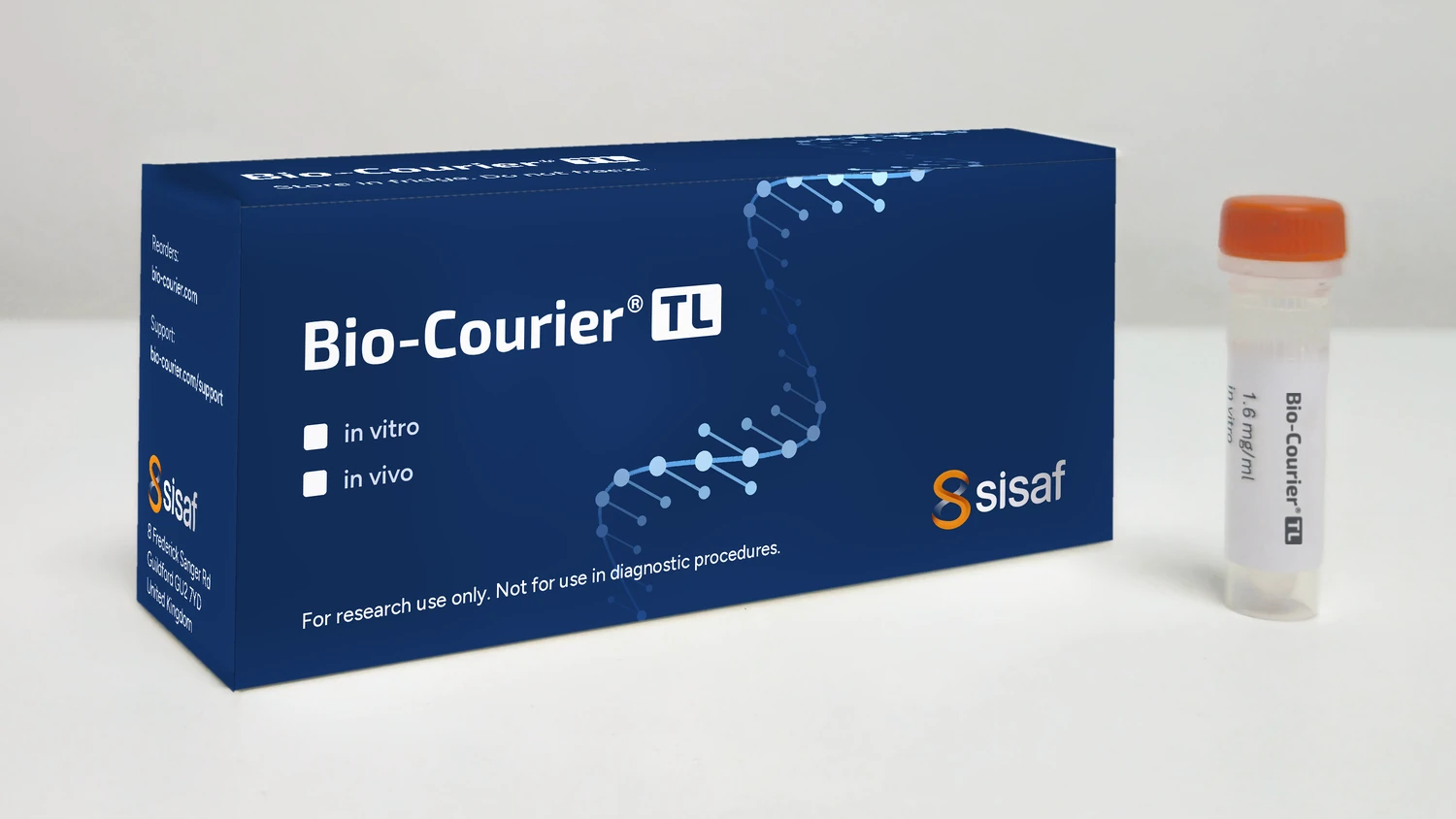
Bio-Courier® technology will soon be available as a research reagent.
One reagent for in vitro and in vivo
Unlike other reagents, the same chemistry is used at the bench and in animal studies, with no reformulation between them.
Better payload decisions
Transfection reagents often compromise cell viability, introducing biological noise. Bio‑Courier® Translate keeps cells viable, so what the assay measures is the payload. And because the same chemistry takes that payload into animal studies, it can be evaluated in vivo without the confounding effects introduced by a different carrier chemistry.

Research Reagent
Launching soon
Bio-Courier® technology will soon be available as a research reagent.
One reagent for in vitro and in vivo
Unlike other reagents, the same chemistry is used at the bench and in animal studies, with no reformulation between them.
Better payload decisions
Transfection reagents often compromise cell viability, introducing biological noise. Bio‑Courier® Translate keeps cells viable, so what the assay measures is the payload. And because the same chemistry takes that payload into animal studies, it can be evaluated in vivo without the confounding effects introduced by a different carrier chemistry.
Bio-Courier® Portfolio
The capabilities of SiSaf’s Bio-Courier platform are not limited to nucleic acid delivery. The technology has been used successfully with a large variety of molecules: small and large, hydrophilic and hydrophobic, peptides, proteins, and antibodies, that have been administered via various routes.
Targeted RNA delivery
sshLNP®
Stabilizes and protects biologicals, in particular nucleic acids. Facilitates cellular targeting and intracellular trafficking of RNA.
Molecules
- Biologicals
- Nucleic acids
Patent protected
Thermostable RNA
ColHySilic®
Protects the carrier-RNA complex from degradation and increases thermostability. Removes the need for an ultra-cold chain for RNA.
Molecules
- Nucleic acids
Patent protected
Stability & solubility
ProSilic®
Improves stability, solubility and targeting of a wide range of molecules.
Molecules
- Small & large molecules
- Antibodies
- Peptides
- Proteins
Patent protected
Oral & dermal delivery
ProSipheres®
Improves delivery of both hydrophilic and hydrophobic drugs for oral and dermal applications.
Molecules
- Molecules with stability issues
Patent protected
Plant health
TriSilic®
Stabilizes molecules for plant health applications.
Molecules
- Molecules that are susceptible to degradation in an aqueous environment
Patent protected
Publications



Bio-Courier: a new delivery technology to increase the global accessibility of RNA therapeutics
Suzanne Saffie-Siebert, Andy Gibson, Ashkan Dehsorkhi
October 2023
Manufacturing Chemist (online)

Novel hybrid silicon-lipid nanoparticles deliver a siRNA to cure autosomal dominant osteopetrosis in mice. Implications for gene therapy in humans
September 2023
Molecular Therapy – Nucleic Acids, VOLUME 33, P925-937

Delivery of siRNA to the Eye
2021
In: Ditzel, H.J., Tuttolomondo, M., Kauppinen, S. (eds) Design and Delivery of SiRNA Therapeutics. Methods in Molecular Biology, vol 2282. Humana, New York, NY, pp 443–453
Topical siRNA delivery to the cornea and anterior eye by hybrid silicon-lipid nanoparticles
October 2020
Journal of Controlled Release, Volume 326, 2020, pp 192-202
Effective Small Interfering RNA Therapy to Treat CLCN7-dependent Autosomal Dominant Osteopetrosis Type 2
January 2015
Molecular Therapy – Nucleic Acids (2015) 4, e248

Nanotechnology approaches to solving the problems of poorly water-soluble drugs
August 2005
Drug Discovery World, Summer 2005

High Yield Incorporation of Plasmid DNA within Liposomes: Effect on DNA Integrity and Transfection Efficiency
Gregory Gregoriadis, Roghieh Saffie & Stephen Hart
1996
Journal of Drug Targeting, 3:6, 469-475
